27 April 2026
How to Find the Operational AI Lever in Your Business: A 5-Step Audit Framework
By We Are Heylo
Most AI projects fail before any code gets written. They fail because the team picked the wrong problem to solve. The interesting question is not "where could AI help" but "where does AI move a number that compounds." This is the framework we use to find that lever inside a real operation, in a week.
It works because it deliberately ignores the question of which AI technique to use until the very last step. Picking the technology before you've found the lever is the most common error in AI strategy.
Why this matters
Picking the wrong AI lever costs around SGD 80k to 250k in wasted build time, depending on how far the project gets before someone realises it. The bigger cost is opportunity. Six months on the wrong project means six months not finding the right one. For a Singapore SME with one shot at an AI investment this year, the framework you use to choose the project matters more than the engineering team you pick to build it.
Step 1: Catalogue the highest-cost workflows
Sit with your operations lead for two hours and write down the ten workflows that consume the most human time or carry the highest variable cost. Don't sort by importance. Sort by raw time or money flowing through them.
For a Singapore F&B group, these might be inventory reconciliation, supplier invoice processing, shift scheduling, customer feedback triage, menu pricing analysis. For a logistics business, route planning, exception handling, customer status enquiries, claims processing. For a B2B services firm, proposal generation, time tracking reconciliation, lead qualification, support escalation.
Be brutally specific. "Customer service" is not a workflow. "Triaging the 200 customer service messages we receive each day in WhatsApp, Instagram and email" is a workflow.
Step 2: Quantify the financial weight
For each of the ten workflows, write down two numbers.
Current cost. Labour hours per week multiplied by burdened cost per hour, plus any direct vendor cost. If a workflow consumes 40 hours per week of a SGD 60/hour employee, the labour cost alone is around SGD 125k per year.
Variable cost compounded. Some workflows generate errors that compound. A 1% forecast error on SGD 5M annual inventory is SGD 50k. A 5% wastage rate on stock you could otherwise recover is whatever 5% of your inventory turn costs.
After this step you should have a ranked list. The top three workflows by cost are where you focus next. Everything below the top three is noise for now.
Step 3: Probe the data conditions
For each of the top three workflows, answer five questions honestly.
- Is the data captured? Is the input to this workflow already in a digital system, or does someone re-key it from paper, email, or memory?
- Is the data clean? Is it structured consistently, with names, IDs, and formats that match across records?
- Is the data accessible? Can the AI system reach it via an API or database query, or is it locked inside a SaaS product without export?
- Is the data fresh enough? If the workflow happens daily, is the data updated daily?
- Is the data labelled? For tasks that require historical examples (most useful AI tasks), do you have records of past decisions and their outcomes?
A workflow that scores well on three or more of these is buildable. A workflow that scores well on fewer is a data project before it's an AI project.
This step kills more candidates than any other. Most Singapore SMEs we audit have workflows that look obvious for AI, where the data turns out to live in three different SaaS products with no API.
Step 4: Test the lever's compounding properties
For each surviving candidate, ask one more question. Does the value compound?
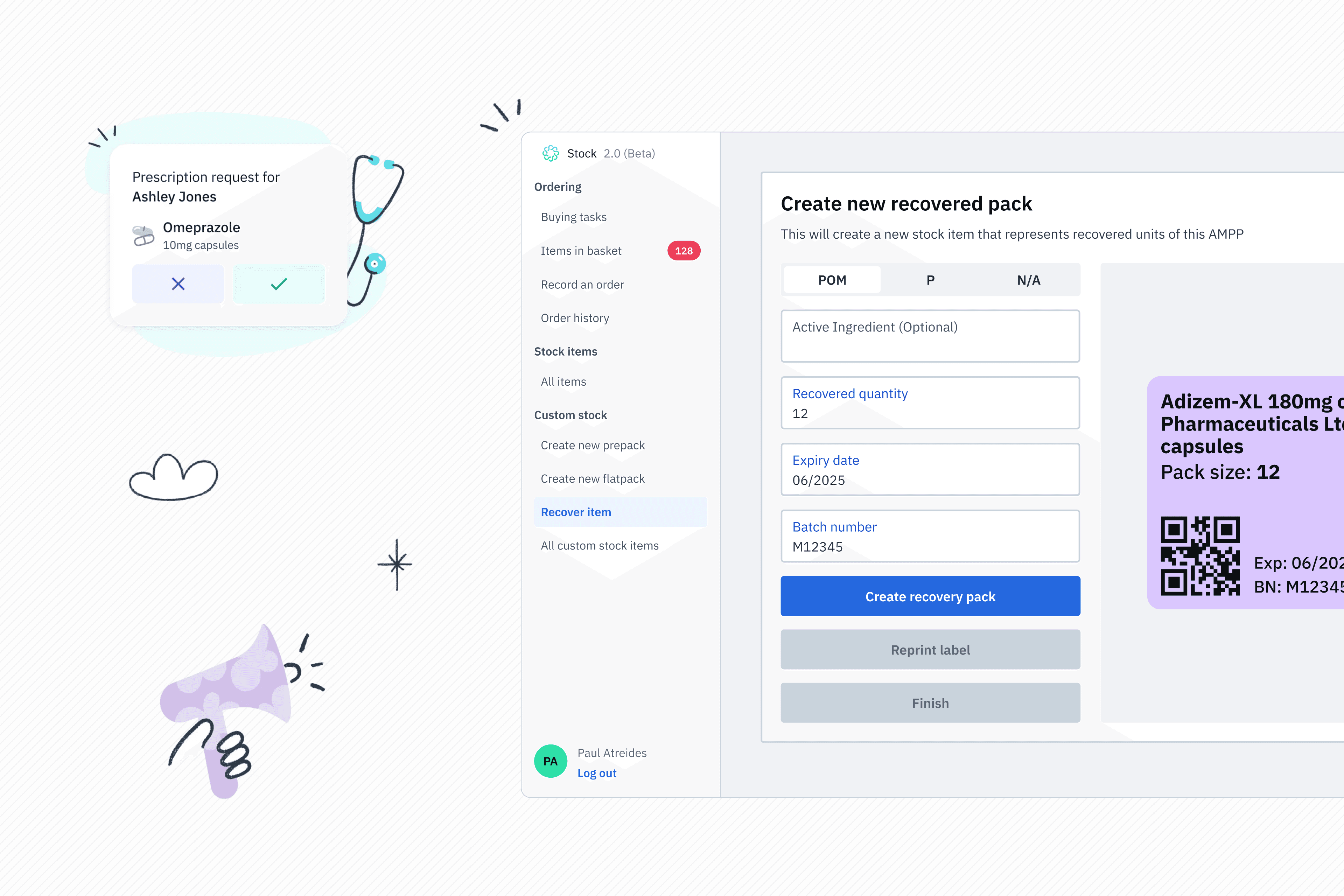
A workflow where AI saves 10 hours a week, every week, is a small compounding lever. A workflow where AI prevents an error that grows quadratically with volume is a large compounding lever. The LloydsDirect stock recovery system is an example of the latter: each pack recovered avoids waste that would compound across the entire dispensing volume.
Compounding properties to look for:
- Volume that grows with your business
- Errors that propagate downstream
- Decisions that affect every transaction
- Workflows that gate other workflows
Workflows without compounding properties are still worth automating, but rarely worth a bespoke build. They belong in the "buy a SaaS tool" tier.
Step 5: Now (and only now) pick the technique
After steps 1 to 4, you should have one or two workflows that are high-cost, well-supplied with data, and compound. This is the point at which you can sensibly ask "which AI technique applies."
Common operational levers map to common techniques:
- Pattern recognition in high-volume transactions → classification model
- Document parsing and extraction → LLM with structured output
- Forecasting demand or staffing → time-series model
- Customer-facing Q&A → RAG (retrieval-augmented generation)
- Routing or assignment decisions → recommendation or ranking model
- Anomaly detection → unsupervised or semi-supervised model
You don't need to know which one you'll use before this step. You just need the lever to be real first.
Worked example
A Singapore food distributor with SGD 8M annual revenue ran this audit. The workflow that surfaced was supplier invoice processing: 250 invoices per week, 12 hours of admin time, 4% error rate creating downstream payment disputes. Annual cost of errors and admin: roughly SGD 80k.
Data conditions: invoices arrive as PDFs in a shared mailbox (captured but not structured), no API exposure (inaccessible), no labelling.
Step 3 killed the candidate as "AI project". Step 4 promoted it to "data project first." The right next move was a six-week pipeline build to capture invoices into a structured store, then a follow-on AI build to classify and extract line items. The audit prevented a SGD 60k mistake of trying to skip the data work.
The actual lever turned out to be customer reorder forecasting (compounding, high-volume, clean data because it lived in the order management system). That became the AI project.
The audit took five days. The mistake it prevented would have cost the business two months of build time and around SGD 80k.
What the audit produces
The output of a well-run operational AI audit is a single document, no more than ten pages, that includes:
- The top three workflows by financial weight, with the numbers
- The data conditions score for each
- The compounding analysis
- The recommended technique for the winning workflow
- A realistic cost and timeline for the build
- The criteria for declaring success or stopping
If your consultant produces a 60-slide deck at the end of a discovery week, they didn't do this work. They did a different kind of work, called "selling more consulting."
The bottom line
The five steps in order: catalogue the workflows, quantify their financial weight, probe the data, test for compounding, then (and only then) pick the technique. Run them honestly and the right project usually surfaces. Skip steps and you'll spend six months and SGD 100k discovering you picked the wrong one.
This article was written by the team at
We Are Heylo
We're an AI consulting and product engineering studio for operators who need the numbers to move. Singapore-based.
Related articles
How We Embed in a Business for a Week (the Operational AI Audit)
An honest walkthrough of what happens during our Phase 0 audit week. Who we talk to, what we look at, what we produce, and why most consultants skip this work.
AI Governance in Singapore: PDPA, the Model AI Framework, and What SMEs Need to Know
A practical guide to AI governance for Singapore SMEs. The Model AI Governance Framework, PDPA touchpoints, IMDA's autonomous agent guidance, and what to do this quarter.
AI for Healthcare in Singapore: Operational Use Cases (Not Diagnosis)
The AI use cases that actually deliver value in Singapore healthcare in 2026 are operational, not clinical. Here's where to start and how to think about HSA, PDPA and consent.