28 February 2026
How to Integrate AI Into Your Singapore Business (2026 Guide)
By We Are Heylo
Singapore's government has committed over S$1 billion to AI development through the National AI Strategy 2.0. Enterprise Singapore is running AI adoption grants. Every conference in the CBD has "AI-powered" somewhere in the programme. The signal is clear: AI isn't optional for businesses that want to stay competitive.
But there's a gap between "we should use AI" and actually doing it. Most businesses we speak to are stuck in that gap. They know AI matters, they've seen the demos, but they don't know where to start, or they've started in the wrong place and wasted money on pilots that went nowhere.
This guide is the framework we use with our own clients. It's practical, it's specific to Singapore's market, and it skips the hype.
Why Singapore businesses should care about AI right now
Three things are converging in 2026 that make this the right moment:
The technology is production-ready. Two years ago, large language models were impressive demos. Today, they're reliable enough to handle real business processes. Document understanding, natural language processing, and decision-support systems have matured from experimental to dependable.
Singapore's competitive landscape is shifting. Early adopters are already gaining advantages in customer service response times, operational efficiency, and data-driven decision making. The businesses that wait another 12-18 months will be playing catch-up against competitors who've already built their AI capabilities.
The cost has dropped dramatically. Running an AI model that would have cost thousands per month in 2024 now costs a fraction of that. API pricing from OpenAI, Anthropic, and Google has fallen consistently, and open-source alternatives are viable for many use cases. AI integration is no longer an enterprise-only play.
The 5-step AI integration framework
Step 1: Audit your current processes
Before you touch any AI tool, map out your existing workflows. Every one of them. Focus on:
- Time-intensive manual tasks. Where are your people spending hours on repetitive work?
- Data bottlenecks. Where does information get stuck, delayed, or lost in translation?
- Error-prone processes. Where do mistakes happen most frequently?
- Customer-facing friction. Where do customers wait, get frustrated, or drop off?
Be specific. "We have inefficient processes" is useless. "Our accounts team spends 15 hours per week manually entering invoice data from PDFs into our accounting system" is actionable.
Step 2: Identify high-impact use cases
Not every process is a good candidate for AI. The best targets have three characteristics:
- High volume. The task happens frequently enough that automation saves meaningful time.
- Structured enough to define. You can clearly describe what "good" looks like.
- Tolerance for imperfection. The consequences of occasional errors are manageable, or human review is built in.
Score each candidate on effort vs. impact. Start with the quadrant that's low effort, high impact. Leave the complex, transformative projects for later, once you've built internal confidence and capability.
Step 3: Prototype fast
Build a working proof of concept in weeks, not months. The goal isn't perfection. It's validation. You need to answer one question: does this actually solve the problem?
For most SMBs, prototyping means:
- Using existing AI APIs (OpenAI, Anthropic, Google) rather than training custom models
- Building a minimal interface that lets real users test the workflow
- Measuring actual performance against the manual process
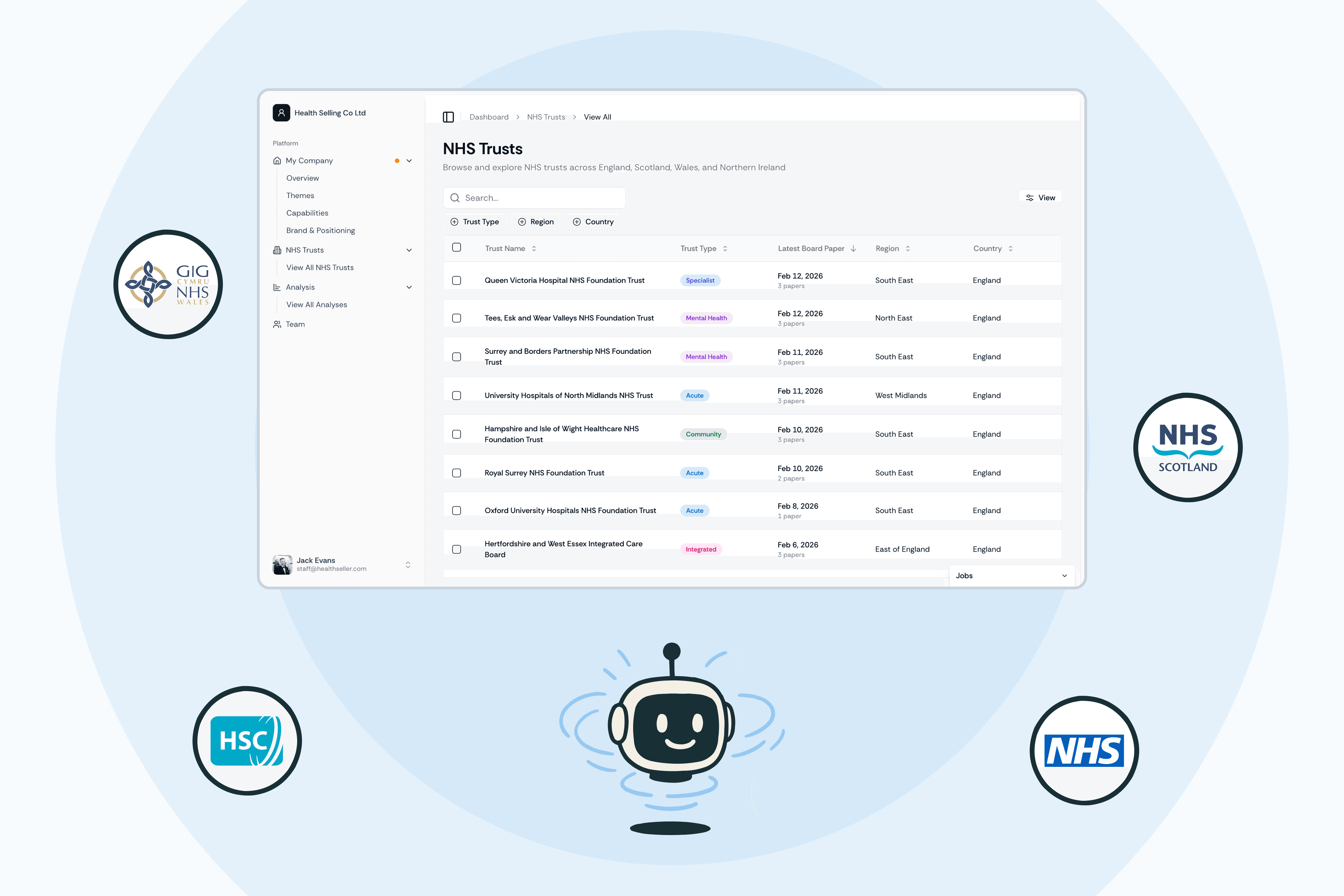
Our founder built the prototype for Board Paper Scraper, an AI platform that analyses 120-page NHS board papers, in weeks. The first version was rough, but it proved the core insight: AI could extract qualified sales leads from dense documents faster and more accurately than a human researcher. That validation justified the full build.
Step 4: Build for production
A prototype that works on your laptop isn't a product. Production AI systems need:
- Reliability. Error handling, fallback logic, graceful degradation when the AI model is uncertain.
- Monitoring. Tracking accuracy, latency, cost, and edge cases over time.
- Integration. Connecting to your existing systems (CRM, ERP, helpdesk, databases).
- Security. Proper data handling, especially important in Singapore where PDPA compliance is non-negotiable.
- Human oversight. Clear escalation paths for cases the AI can't handle confidently.
This is where most DIY AI projects fail. The gap between "it works in a demo" and "it works reliably at scale every day" is enormous.
Step 5: Measure and iterate
Define your success metrics before you launch, not after. Good metrics are:
- Time saved per process (hours/week)
- Error rate compared to the manual process
- Cost per transaction (AI vs. human)
- User adoption. Are your team actually using it?
- Customer impact. Has response time, satisfaction, or conversion improved?
Review monthly. AI systems improve with feedback and fine-tuning, but only if you're tracking the right data.
Which AI applications actually work for SMBs
Let's be honest about what's real and what's still hype.
Works well today:
- Document processing and data extraction. Invoices, contracts, reports, forms. AI reads them, extracts structured data, and feeds it into your systems. This is one of the highest-ROI applications for most businesses.
- Customer service chatbots. Not the frustrating scripted bots of five years ago. Modern AI chatbots understand context, handle complex queries, and escalate gracefully when they're out of their depth.
- Content generation and summarisation. Drafting reports, summarising meeting notes, generating product descriptions, creating first drafts of marketing copy.
- Email triage and routing. Automatically categorising incoming emails, routing them to the right person, and drafting suggested responses.
- Lead scoring and qualification. Analysing prospect data to prioritise which leads deserve attention first.
Getting there but needs careful implementation:
- Voice AI agents for phone support
- Predictive analytics for inventory and demand
- Automated compliance checking
Still mostly hype for SMBs:
- Fully autonomous AI agents that run your business
- AI that replaces your entire customer service team
- Off-the-shelf AI solutions that work without customisation
Common mistakes businesses make with AI
Over-scoping the first project. The number one killer. A business decides their first AI project should be a complete overhaul of their customer experience. Six months later, they've spent $100,000 and have nothing in production. Start small. Get a win. Build from there.
Ignoring data quality. AI is only as good as the data you feed it. If your customer records are messy, your documents are inconsistent, or your processes aren't documented, fix that first. No AI tool will compensate for bad data.
Choosing the wrong use case. Not everything should be automated. If a process requires nuanced human judgement, deep relationship context, or creative thinking, AI probably isn't the answer yet.
Building when you should buy. For standard use cases like chatbots, email automation, or document processing, there are mature SaaS products that work out of the box. Custom development only makes sense when your needs are genuinely unique.
Not involving end users. The people who'll actually use the AI system need to be involved from day one. Build with them, not for them. An AI tool that your team resists using is worthless regardless of how technically impressive it is.
Real costs and realistic timelines
Here's what AI integration actually costs for Singapore SMBs:
| Project Type | Investment (SGD) | Timeline | Ongoing Cost |
|---|---|---|---|
| AI chatbot (custom-built) | $8,000-$25,000 | 4-8 weeks | $200-$1,000/month |
| Document processing automation | $10,000-$40,000 | 6-12 weeks | $300-$1,500/month |
| AI-powered email triage | $5,000-$15,000 | 3-6 weeks | $100-$500/month |
| Full workflow automation | $20,000-$60,000 | 8-16 weeks | $500-$3,000/month |
| AI strategy and roadmap | $3,000-$8,000 | 2-4 weeks | N/A |
Ongoing costs include API usage (paying for AI model calls), hosting, and maintenance. These scale with usage, so a business processing 100 documents per day will pay more than one processing 10.
The timeline assumes working with an experienced team. DIY timelines are typically 2-3x longer, and the production-readiness gap means many DIY projects never ship at all.
When to build vs. buy vs. hire
Buy when a mature SaaS product solves your exact problem. Tools like Intercom (AI customer service), Dext (receipt processing), or Notion AI (content workflows) are battle-tested and cost-effective for standard use cases.
Build when your needs are specific to your business, your data is proprietary, or no off-the-shelf product fits your workflow. Board Paper Scraper is a good example from our portfolio. No existing tool could analyse NHS board papers and generate sales leads. That required custom AI development.
Hire (an agency or consultant) when you need strategic guidance on where to start, when the technical build is beyond your internal capability, or when you need a production-grade system built quickly. The right partner should be able to do both strategy and execution, not just hand you a report.
Summary: the five steps
- Audit your processes to find where time, money, and accuracy are being lost.
- Identify high-impact use cases that are high-volume, well-defined, and tolerant of imperfection.
- Prototype fast using existing AI APIs, validate the approach in weeks.
- Build for production with proper reliability, monitoring, integration, and PDPA compliance.
- Measure and iterate monthly against pre-defined success metrics.
Get started with an AI readiness assessment
If you're serious about AI but unsure where to start, we offer an AI readiness assessment. We audit your current processes, identify the highest-impact opportunities, and give you a prioritised roadmap with realistic costs and timelines.
No 100-page deck. No theoretical frameworks. Just a clear, actionable plan based on what will actually make a difference for your business.
Talk to us about AI integration. We'll tell you honestly whether AI is the right move for your business right now, or whether your money is better spent elsewhere.
This article was written by the team at
We Are Heylo
We're an AI consulting and product engineering studio for operators who need the numbers to move. Singapore-based.
Related articles
How We Embed in a Business for a Week (the Operational AI Audit)
An honest walkthrough of what happens during our Phase 0 audit week. Who we talk to, what we look at, what we produce, and why most consultants skip this work.
How to Find the Operational AI Lever in Your Business: A 5-Step Audit Framework
Most AI projects fail because they target the wrong problem. This is the framework we use to find the lever AI can actually pull inside a real operation.
AI Workflow Automation: 10 Business Processes You Should Automate Today
The 10 highest-ROI business processes for AI automation, with real time savings, cost data, and a framework for deciding where to start.